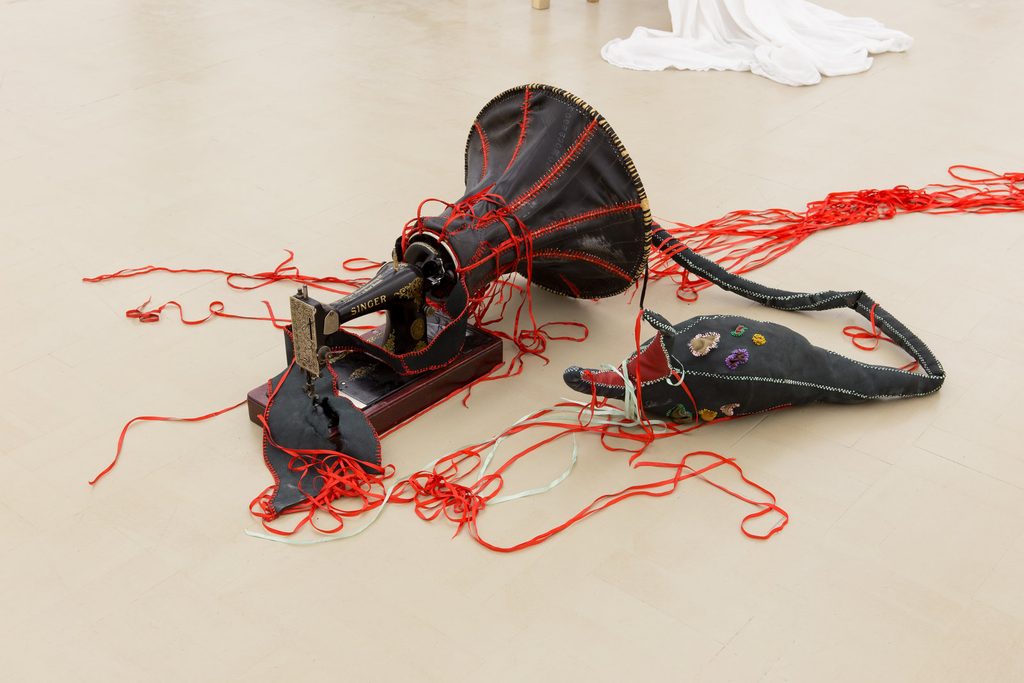
Picture a room bathed in pink light. Hanging from the ceiling is an 18-foot creature made of rubber inner tubes and ribbon, part car tyre, part flesh, part something you can’t quite name. That was Vula zibhuqe, the piece that introduced American audiences to Nicholas Hlobo at ICA Boston in 2008. It’s as good a place as any to start understanding an artist whose entire practice feels like a body being taken apart and lovingly sewn back together.
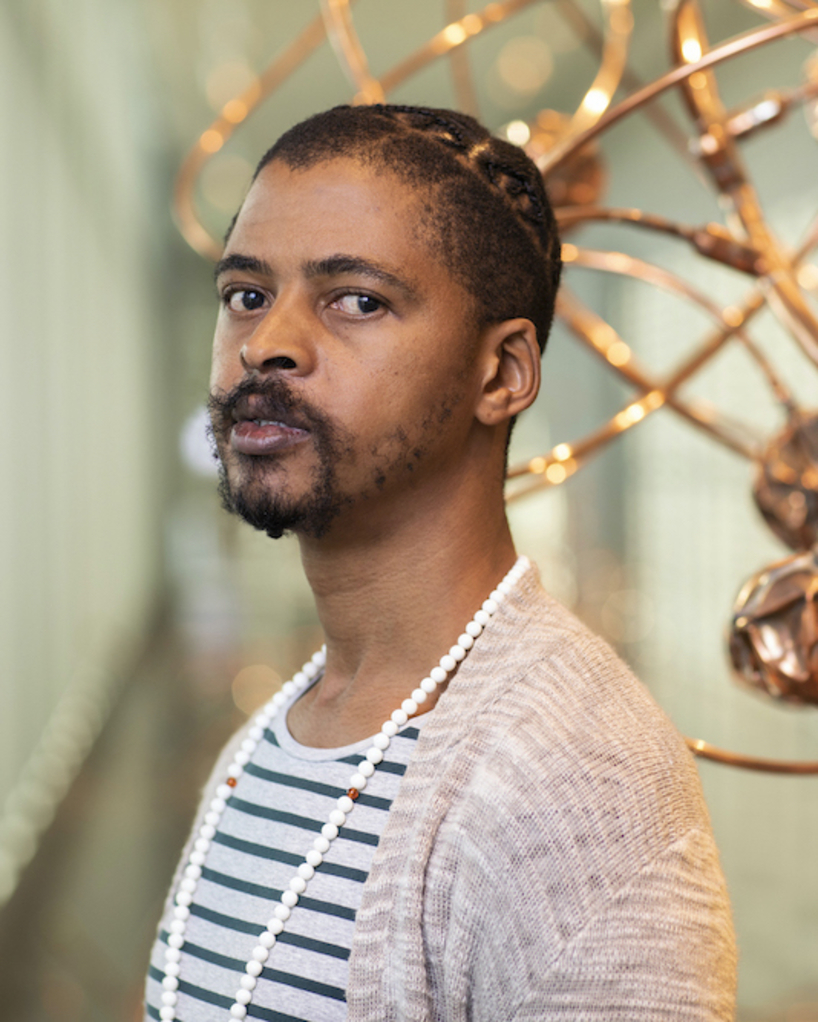
From Late Bloomer to International Force
Nicholas Hlobo didn’t set out to become one of Africa’s most important living artists. Born in Cape Town in 1975, he didn’t turn seriously to art until his mid-to-late twenties, graduating with a Fine Art degree from Johannesburg’s Technikon Witwatersrand in 2002, right as post-apartheid South Africa was still figuring out what it wanted to become. Within a few years, so was he. By 2008 he was showing at Tate Modern. By 2009 he had won the Standard Bank Young Artist Award, one of the country’s most prestigious honours.
That speed matters. Hlobo isn’t an artist who spent decades quietly refining a style before anyone noticed. He arrived nearly fully formed, using his own body and biography as raw material from day one. As a queer Xhosa man working in a country still untangling colonialism, apartheid, and rigid ideas of masculinity, he turned his identity into an artistic language almost immediately, and the art world took notice.
The Materials Are the Message
Here’s what makes Hlobo genuinely unlike almost any other sculptor working today. He builds his art the way a body heals: by cutting, then stitching. Across his sculptures runs a signature “baseball” stitch, thick and visible, like a scar nobody is trying to hide. That’s not incidental. Hlobo treats his cutting and sewing process as a kind of metaphor for wounding and healing, a way of processing colonisation’s damage without pretending it never happened.
Then there’s the material game he plays with gender itself. Rubber, often literal inner tubes from car tyres, carries a distinctly masculine charge in South African culture, tied to automobiles as status symbols but also to condoms and sadomasochistic subculture. Ribbon and lace pull in the opposite direction, bringing softness and domesticity traditionally coded as feminine. Hlobo never picks a side. He crashes these materials into each other, and the resulting sculptures, full of phallic and ovarian forms and shapes that feel anthropomorphic without being quite human, refuse to sit still in one category. Even his titles resist easy translation, drawn from the Xhosa language and loaded with double meanings most gallery visitors will never fully unpack.
A Career Built on Big, Strange, Beautiful Objects
Hlobo’s debut solo show, Izele, opened at Stevenson in Cape Town in 2006, modest compared to what came next. His 2008 Tate Modern show, Uhambo, changed everything. One piece from that period, Ingubo Yesizwe, a hybrid creature stitched from leather and rubber inner tubes, takes its title from a Xhosa phrase meaning “clothes of the nation”, referencing the ritual use of cowhide to cover a corpse before burial. It’s a typical Hlobo move: an object that’s visually strange, materially loaded, and quietly devastating once you know what it’s referencing.
Since then, his work has travelled relentlessly, appearing in:
- Tate Modern’s Energy and Process (London, 2016)
- The 18th Biennale of Sydney (2012)
- Art/Afrique at the Fondation Louis Vuitton (Paris, 2017)
- Performa 17 (New York, 2017)
- The Barbican Centre’s Unravel: The Power and Politics of Textiles in Art (London, 2024)
In 2010, he was chosen for the Rolex Mentor and Protégé Arts Initiative, spending a year working directly under sculptor Anish Kapoor, a mentorship most emerging artists can only dream about. He’s since collected the Villa Extraordinary Award for Sculpture (2016) and the Tollman Award for Visual Art (2006). His work now lives permanently in institutions like Zeitz MOCAA, the Perez Art Museum Miami, and François Pinault’s collection at the Palazzo Grassi in Venice.
Why He’s Impossible to Ignore
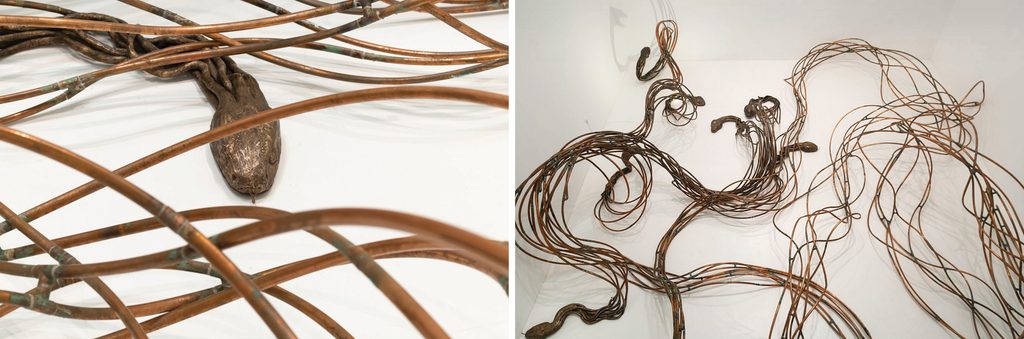
Curators keep coming back to Hlobo for a simple reason. He makes objects that are genuinely hard to look away from: strange, tactile, faintly erotic, and faintly ceremonial, while smuggling in some of the most urgent questions in contemporary South African life. What does masculinity mean after apartheid? What does healing actually look like when it’s made physical, material, and sewn together in front of you? Can a sculpture built from car tyres and lace hold both a wound and a celebration at once?
Hlobo’s answer, sculpture after sculpture, seems to be yes, and it’s more interesting than choosing one or the other.